LIVING IN THE LIGHT OF GOD

Living in the Light
This is the message we heard from Jesus* and now declare to you: God is light, and there is no darkness in him at all. If we say we have fellowship with God but go on living in spiritual darkness; we are not practicing the truth; we are lying. If we are living in the light, as God is in the light, then we have fellowship with each other, and the blood of Jesus, his Son, cleanses us from all sin. If we claim we have no sin; we are only fooling ourselves and not living in the truth. If we confess our sins to him; he is faithful and just to forgive us our sins and to cleanse us from all wickedness. If we claim we have not sinned, we are calling God a liar and showing that his word has no place in our hearts (1 John 1:5–10 NLT).[1]

Just as Christ passed on the message he heard from the Father, so the apostles in turn were passing on the same message that they heard from the Son. John did not use the term “gospel,” but he did use such words as “witness,” “testimony,” “word,” “truth,” and “message.”
John’s message emphasized that God is light. Light enables people to do their work. It produces growth in crops; it reveals beauty, and provides safety.
Light represents what is good,
pure, true, holy, and reliable. Light reveals; light shines. God is so
completely “light” that in Him is no darkness
at all.
“Darkness” represents what is
sinful and evil. The Greek could be translated literally as “darkness is not in
him ever.” God is untainted by any evil or sin. Thus, “God is light” means that
God is perfectly holy and true and that he alone can guide people out of the
darkness of sin.
Genesis 1:3 records God’s
expression of his nature and will in the statement “Let there be light.” Jesus
declared himself to be the “light of the world” (John 8:12). In 1 Timothy 6:16,
Paul expressed that God “lives in light so brilliant that no human can approach
him” (nlt). This light signifies
Christ’s moral excellence and purity. John was one of only three eyewitnesses
to Jesus’ transfiguration (see Matthew 17:1–13) where Jesus was described as
being “dazzling white.” The light reflected God’s essence.
LIGHT VS. DARKNESS
In many places in Scripture, the realm of God and the realm of evil are contrasted by the differences between light and darkness:
|
Darkness |
Light |
Reference |
|
Despairing
condition |
Hopeful
condition |
Isaiah 9:2 |
|
Inability to
recognize the light |
Ability to
enlighten the world |
John 1:4–5, 9 |
|
The power of
Satan |
The power of
God |
Acts 26:18 |
|
Evil deeds |
Good deeds |
Romans
13:12–14 |
|
Natural heart
condition |
Gift from God |
2 Corinthians
4:6 |
|
Fruitless
works |
Source of all
that is good |
Ephesians
5:8–11 |
|
Spiritual
forces of evil |
Armor of God |
Ephesians
6:12–13 |
|
Powerful
captivity |
Kingdom of
the Son, redemption, forgiveness |
Colossians
1:12–14 |
|
Inability to
exist in God’s presence |
God’s
presence, fellowship with God |
1 John 1:5, 7 |
|
Transient
nature |
Permanent
nature |
1 John 2:8–11 |
Light also relates to truth, because light exposes whatever exists, whether it is good or bad. In the dark, good and evil look alike; in the light, they can be clearly distinguished. Just as darkness cannot exist in the presence of light, sin cannot exist in the presence of a holy God.
“Darkness” can also picture a certain hiddenness and secrecy. The false teachers claimed to have received special knowledge that God only gives to a certain few. The nature of light, however, is to flood and fill. That God has “no darkness” means that nothing is hiding in shadows or kept in secret.

“God
is light” and there is no darkness at all in him (1:5). While “light” has many
connotations, this reference points specifically to God’s purity. Therefore,
those who claim to have fellowship with God are living in God’s light, trying
to live holy and pure lives for him. To claim to belong to God but then to go
out and live in sin is hypocritical. In fact, John says that people are lying if they claim fellowship with God but go on living in spiritual darkness. Christ
will expose and judge such deceit.
JOHN COUNTERS FALSE TEACHINGS
John countered two major false teachings of the heretics in this letter:
- They denied the reality of sin. John wrote that those who continue in sin do not belong to God. Those who say they have no sin only fool themselves and refuse to accept the truth. (1:6, 8, 10)
- They denied that Jesus was the Messiah-God in the flesh. John said that those who believe that Jesus is God incarnate and trust him for salvation are children of God. (2:22:4:1–3)
Those who claim to know God must
also be living in the light, for darkness and light are incompatible. People
cannot live both in the darkness of sin and in the light of fellowship with
God, in whom is “no darkness at all” (1:5). John often used “darkness” to refer
to sin (1:5, 6; 2:8, 9, 11). Thus, one cannot live a sinful life and
simultaneously claim to be a Christian.

1:7 But if we are living in the light of God’s presence, just as Christ is,
then we have fellowship with each other, and the blood of Jesus, his Son,
cleanses us from every sin. NLT
Because “God is light” (1:5), the Son of God lives in pure light and contains the light of God in himself. Those who claim to follow the Son cannot live in spiritual darkness (see 1:6, meaning ignorance and immorality); instead, they must be living in the light of God’s presence. They must be illumined by the truth of God’s character. To “live in the light” requires constant contact with God and no tolerance for dishonesty, hypocrisy, or sin. Living in the light pictures a life of complete transparency, with no attempts to conceal anything from “the Light.” To “walk in the light” (as it is translated in niv and nkjv) cannot come from imitating other Christians; instead, it comes from the continuous effort to take on Christ’s qualities. This involves a complete transformation from within.
LIFE APPLICATION
COMING OUT
John
wanted his readers to understand how to discern between true and false
teachers. Because some had left the congregations to follow false teachers and
start their own churches, many of the believers had been left confused. John
said, first of all, that they should look at whether a leader’s teaching and
behavior were consistent with each other and then consider whether the teaching
was consistent with the message the apostles had given them. It is a lie to
claim to be a Christian but deny its moral foundation by living in sin and
immorality. Today many Christians profess Christ but live so enmeshed in the
values and attitudes of non-Christians that they are indistinguishable from
them. If you love Christ, come out of the dark shadows and back alleys of sin
and immorality. Stand in the light with all your imperfections and look to
Christ, your perfect Light.
Walking in the light leads to fellowship with each other. This fellowship among believers results from each believer’s having fellowship with God. By living in the light, John did not intend that all Christians should be hermits or mystics, living in solitary contemplation of God. Instead, their fellowship with Christ should produce the desire to join others in loving devotion.
John’s overall argument stresses
this: True spirituality manifests itself in community fellowship. One cannot
say that he or she communes with God and then refuse to commune with God’s
people. Such was the case with some of the false teachers of John’s day, and
this situation exists among false cults today. Often their followers and
leaders claim to have special relationships with God, but they don’t affiliate
with other believers. They stay isolated and withdraw from everyone else.
John’s point is that the natural result of living in the light (in fellowship
with God) should be joyful relationships with other Christians.
Another result of walking in the light is that the blood of Jesus, his Son, cleanses us from every sin. John emphasized that the death of Christ (“the blood of Jesus”) saves people, not the false teachers’ knowledge. The verb “cleanses” also means “purifies.” Sin is not only forgiven, it is erased. How does Jesus’ blood do that? In Old Testament times, believers would symbolically transfer their sins to an animal, which they then would sacrifice (see a description of this ceremony in Leviticus 4). The animal died in their place to pay for their sin and to allow them to continue living in God’s favor. God graciously forgave them because of their faith in him and because they obeyed his commandments concerning the sacrifice. Those sacrifices anticipated the day when Christ would completely remove sin. Real cleansing from sin came with Jesus, the “Lamb of God, who takes away the sin of the world” (John 1:29).
Sin, by its very nature, brings death—that is a fact as certain as the law of gravity. Jesus did not die for his own sins; he had none. Instead, by a transaction that humans may never fully understand, he died for the sins of all who will believe. When people commit their lives to Christ and thus identify themselves with him, his death becomes theirs. He has paid the penalty for their sins, and his blood has cleansed them.
LIFE APPLICATION
THE FELLOWSHIP FACTOR
John’s letter is filled with references to “fellowship.” Fellowship means more than a superficial conversation after church or a midweek meal together. The biblical term conveys the idea of a deep sharing of life, partnership together in a common cause, and spiritual oneness. Remember that the intimacy and fulfillment of biblical fellowship (whether with God or with others) first require a relationship. This six-question test will help determine the quality of the fellowship within a relationship:
- Are there any unresolved tensions or conflicts in the relationship? (If so, these must be addressed.)
- Are we spending adequate time together? (If not, there can never be intimacy!)
- Are we communicating openly and honestly? (The sharing of thoughts, concerns, feelings, plans—even motives—is indispensable to true fellowship.)
- Do we share the same vision? (If we are going in two different directions, it will be impossible to be partners.)
- Are we committed to this relationship? (If the relationship is not a priority, then the fellowship will never be a reality!)
- Are we laying aside our own agendas and looking out for the best interests of others? (Self-centeredness cannot coexist with fellowship.)
Those who “walk in the light,” the true believers, will still find themselves at times in sin. Christians will not be made completely perfect until Jesus returns and brings them into his kingdom. Until then, however, they desire to walk in the light and so refuse to consciously harbor sin. When they do sin, however, God has already made provision to deal with those sins through the blood of his Son. He died, not just for their past sins, but for all their sins that will be committed until the day of his return. These also are taken care of by his blood. That provision allows God’s people to continue to walk in the light—dealing with sin through confession and receiving his forgiveness so that fellowship with God and with others can remain unhindered.
John attacked the second claim of the false teachers (see also 1:6 and 1:10): that people could be “without sin.” The false teachers refused to take sin seriously. In saying that they had no sin, they may have been saying that they did not need Jesus’ death on the cross. They may have considered that Jesus’ death abolished all sin, including the ability to sin. Or, they may have been teaching the false notion that the spirit and body are completely separate and that whatever a person does in the body does not affect the spirit.
LIFE APPLICATION
THE INEVITABILITY OF SIN
This passage touches on one of
the great mysteries of the Christian faith: the fact that although Christians
are cleansed from sin, they still sin. What facts do we need to remember? First,
sin has absolutely no power over Christians (Romans 6:6–7)! Because of our real
union with Christ in his death and resurrection, we have a new power to say no
to temptation (1 Corinthians 10:13) and yes to righteous living (Romans
6:11–14). Second, our old selfish, sinful nature—coupled with our
inability to grasp our new identity as children of a holy God—leaves us
vulnerable to temptation. As fallen (yet redeemed) people living in a fallen
world, we will always struggle with sin.
In light of these facts, we
Christians should admit our weakness to God; we should confess rather than
rationalize or deny. Trust him for the power to live as he commands. When you
do fail, run to him (not from him) for he stands ready to
forgive, cleanse, and empower us.
John explained that those who believe the possibility of human sinlessness are fooling themselves and refusing to accept the truth. What “truth” were the false teachers refusing to accept? This reference to “the truth” refers to spiritual reality and veracity that could be verified by the apostles or other believers as being true (in both life and doctrine) to the teachings of Christ. To claim to have the truth and to refuse to accept humanity’s inherent sinfulness is foolish. The truth of God’s Word does not change: people are sinful. Though Jesus condemned sin once for all, Christians still sin.
The struggle between the old
nature and the new nature will continue until Christ comes to make his people
perfect. Paul wrote about this struggle in Romans 7. Anyone who honestly looks
at his or her inner life and claims to be sinless is refusing to accept the
truth. John wanted his readers to understand that Christians still battle with
sin, but God has provided the blood of Jesus to cleanse his people (1:7) and
the promise of forgiveness when they do sin (1:9).

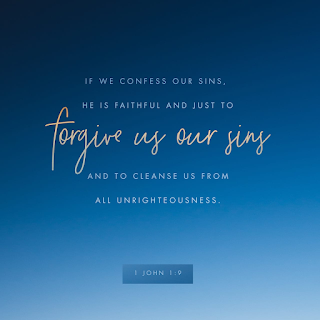
1:9 If we confess our sins, He is faithful and just to forgive us our sins
and to cleanse us from all unrighteousness. NKJV
Being God’s people does not mean denying sin (1:8), but confessing it. Because all people are sinners, Jesus had to die. Because sin is not completely eradicated from the lives of those who believe in Jesus, God graciously gave his followers provision for the problem of sin. John explained it here in a nutshell: If we confess our sins, He is faithful and just to forgive us our sins and to cleanse us from all unrighteousness.
To “confess our sins” means to
agree with God that an act or thought was wrong, to acknowledge this to God, to
seek forgiveness, and to make a commitment to not let it happen again.
Augustine observed that confession of sin is a sign that truth, which is itself
light, has already begun to illuminate people’s sin-darkened lives. Refusing to
admit sin is self-deception. No one can fool God. By refusing to admit sin,
however, people cheat themselves out of the possibility of fellowship with him.
So, confession of sins is necessary for maintaining continual fellowship with
God, which in turn will enable people to have good fellowship with members of
the church community. Rather than denying the sin nature, believers are to
confess their sins because God says they are sinners who need forgiveness. If
this is not so, then his Son’s death would be worthless. To confess sins means
to agree with God concerning specific acts that have been committed; it means
to admit sinfulness.
Confession is supposed to free
people to enjoy fellowship with Christ. It should ease their consciences and
lighten their cares. But some Christians do not understand how it works. They
feel so guilty that they confess the same sins over and over; then they wonder
if they might have forgotten something. Other Christians believe that God
forgives them when they confess, but if they died with unconfessed sins, they
would be forever lost.
These Christians do not
understand that God wants to forgive
people. He allowed his beloved Son to die just so he could offer them pardon.
When people come to Christ, he forgives all the sins they have committed or
will ever commit. They don’t need to confess the sins of the past all over
again, and they don’t need to fear that God will reject them if they don’t keep
their slate perfectly clean. Of course, believers should continue to confess
their sins, but not because failure to do so will make them lose their
salvation. Believers’ relationship with Christ is secure. Instead, they should
confess so that they can enjoy maximum fellowship and joy with him.
“It is the duty of nations as well as of men to confess their sins and transgressions in humble sorrow, yet with assured hope that genuine repentance will lead to mercy and pardon.” ~Abraham Lincoln
LIFE APPLICATION
WHY CONFESSION?
If Christ already forgave all of
our sins when he died on the cross, why does John tell us to “confess our sins”
so that God will “forgive us”? At issue here is our fellowship—not
relationship—with God. When we repent and believe in Christ, we become God’s
children forever. He adopts us into his family, and no sin on our part, no
matter how awful, will ever cause him to “unadopt” us. However, a disobedient
child of God cannot expect to have fellowship with God. This is where
confession comes in. We agree with God (the literal meaning of the Greek term homolegeo) concerning our sin: that it
is wrong, that Christ has paid for it, that it needs to be renounced, and that
it has no power over us. As soon as we do this, we are once again able to enjoy
an intimate, close walk with God. Confess your sins by saying, “I was wrong,
I’m sorry, and I want to change!” To do so will “clear the air” and remove the
sense of distance we feel from our holy, heavenly Father because of sinful
choices we have made. What sins do you need to confess today?
When believers confess their sins, they do not stand in a place of judgment, awaiting their punishment. That punishment has already been paid by Christ. Instead, John explained that God “is faithful and just.”
That God is “faithful” means he
is dependable and keeps his promises. God promises forgiveness, even in the Old
Testament (Jeremiah 31:34; Micah 7:19–20). God wants to forgive his people; he wants
to maintain close fellowship with them. But this can only happen when the way
to him is cleared of sin’s debris—and that
can only happen through confession.
That God is “just” means that he could not overlook people’s sin. He could not decide to let people get away with sin or to make the penalty less severe. “The wages of sin is death” (Romans 6:23). Sacrifices had been offered for sin, and blood had been spilt from the beginning. This could not change because God does not change. Justice would have to be done in order to decisively deal with sin. But instead of making people pay for their sins, God took the punishment upon himself through his Son. In this way, justice was done, and the way was paved for God “to forgive us our sins and to cleanse us from all unrighteousness.” The word translated “forgive” is aphiemi, meaning “cancellation of debts” or “dismissal of charges.” The word for “cleanse” is katharizo, referring to washing away sin (unrighteousness) and restoring holiness. Those who confess their sins to God can trust in his forgiveness because they can trust in his character.
LIFE APPLICATION
SELF-DECEPTION AND SIN
Some of the false teachers,
trying to lead John’s readers astray, claimed that they had not sinned. They
argued that what a person believes is what counts and therefore how he or she
behaves is irrelevant. Even as they pursued this “higher, special knowledge of
spiritual truth,” many lived in decadence. Nothing has changed down through the
centuries. Due to the rising popularity of Eastern, “New Age” philosophies (and
their sharp distinctions between the material and spiritual realms), many
people continue to live as spiritual schizophrenics. They twist and distort the
truth so that they can appear to maintain some semblance of godliness (2
Timothy 3:1–5). Even as they talk convincingly of “seeking God,” they live as
they please. Do not be deceived by these alluring forms of creative
“spirituality.” They are merely clever attempts to justify and rationalize sin.
True faith will always be marked by right moral conduct.

1:10 If we claim we have not sinned, we are calling God a liar and showing
that his word has no place in our hearts. NLT
The false teachers not only denied that sin breaks people’s fellowship with God (1:6) and that they had a sinful nature (1:8), but some even had the audacity to make a third claim—that, even if they did have a sinful nature, they had never actually sinned! They were claiming that they had not sinned. That was a lie that ignored one basic truth: all people are sinners by nature and by practice. This verse parallels 1:8, except that here the focus is on the actual acts of sin emanating from the sinful nature. These false teachers thought that their superior knowledge had placed them out of the realm of sin, rendering them incapable of sinning. This claim went beyond telling a lie (1:6) or merely fooling themselves (1:8); this claim was calling God a liar. God says that all have sinned—otherwise he would not have needed to send his Son. To claim sinlessness treats the Cross with contempt and Christ’s suffering as worthless. To do this, said John, shows that God’s word has no place in our hearts. “This” refers not to the living logos (Jesus) but to the message of the gospel.
John wanted his readers to understand that people who make such a denial of sinful acts do not have the Word of God permeating and changing their lives because the Word of God clearly states throughout that all people sin and all need a Savior (1 Kings 8:46; Psalm 14:3; Isaiah 53:6; 64:6; Romans 3:23; 6:23). People cannot be forgiven if they do not recognize their sin.
“Jesus Christ could not be our advocate in heaven today if he had not died to be the propitiation for our sins; and his propitiation would not have been effective if in his life and character he had not been Jesus Christ, the Righteous One.” ~John R. W. Stott[2]

* 1:5 Greek from him.
[1] Tyndale House Publishers. 2015. Holy Bible: New
Living Translation. Carol Stream, IL: Tyndale House Publishers.
NKJV
Scripture quotations marked NKJV are taken from the New King James Version.
Copyright © 1979, 1980, 1982 by Thomas Nelson, Inc. Used by permission. All
rights reserved.
nlt Scripture quotations marked NLT are taken from the Holy Bible, New Living Translation,
copyright © 1996. Used by permission of Tyndale House Publishers, Inc.,
Wheaton, Illinois 60189. All rights reserved.
NLT
Scripture quotations marked NLT are taken from the Holy Bible, New Living Translation, copyright © 1996. Used by
permission of Tyndale House Publishers, Inc., Wheaton, Illinois 60189. All
rights reserved.
NLT
Scripture quotations marked NLT are taken from the Holy Bible, New Living Translation, copyright © 1996. Used by
permission of Tyndale House Publishers, Inc., Wheaton, Illinois 60189. All
rights reserved.
niv Scripture quotations marked NIV are taken from the Holy Bible, New International Version®.
NIV®. Copyright © 1973, 1978, 1984 by International Bible Society.
Used by permission of Zondervan Publishing House. All rights reserved.
nkjv Scripture quotations marked NKJV are taken from the
New King James Version. Copyright © 1979, 1980, 1982 by Thomas Nelson, Inc.
Used by permission. All rights reserved.
NLT
Scripture quotations marked NLT are taken from the Holy Bible, New Living Translation, copyright © 1996. Used by
permission of Tyndale House Publishers, Inc., Wheaton, Illinois 60189. All
rights reserved.
NKJV
Scripture quotations marked NKJV are taken from the New King James Version.
Copyright © 1979, 1980, 1982 by Thomas Nelson, Inc. Used by permission. All
rights reserved.
NLT
Scripture quotations marked NLT are taken from the Holy Bible, New Living Translation, copyright © 1996. Used by
permission of Tyndale House Publishers, Inc., Wheaton, Illinois 60189. All
rights reserved.
[2] Barton, Bruce B., and Grant R. Osborne. 1998. 1, 2 & 3 John.
Life Application Bible Commentary. Wheaton, IL: Tyndale House.
All Pics From YouVersion Bible App